What Is a Hard Fork? How Blockchain Splits Work, Real Examples and ATO Tax (2026)
Quick Answer
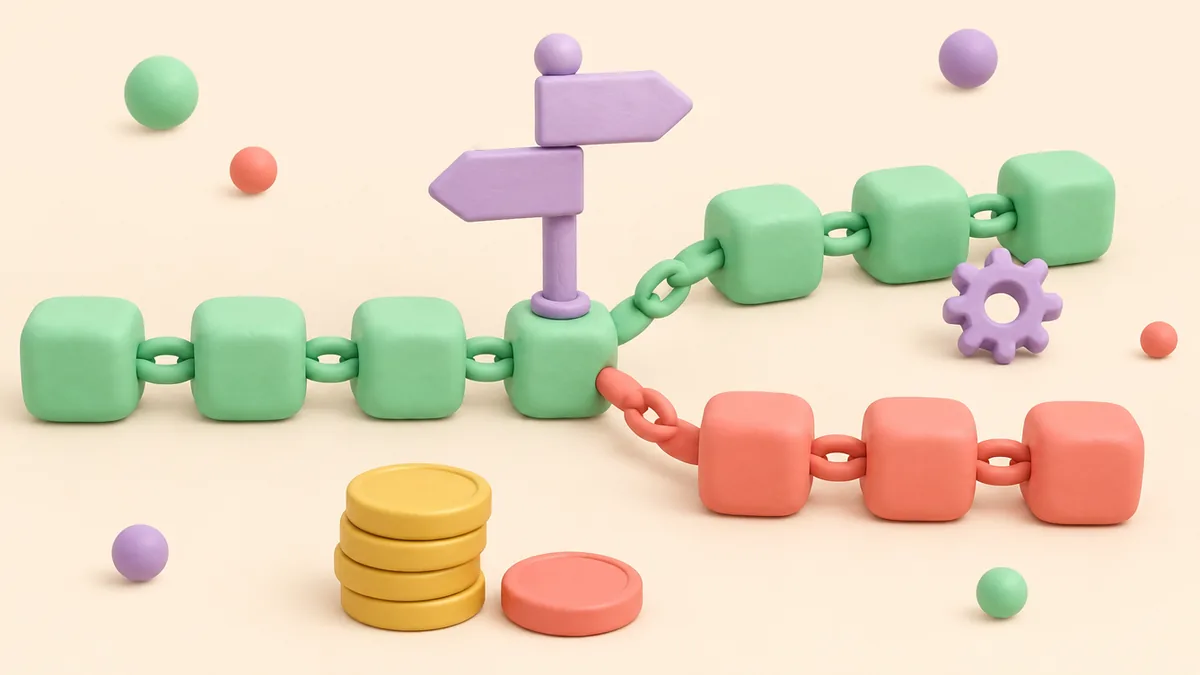
A hard fork is a change to a blockchain's rules that is not backwards compatible. Once it activates, nodes running the new software accept blocks that nodes on the old software reject, so everyone who wants to stay on the network has to upgrade. If the whole community upgrades, the old rules simply die out and there is still one chain, which is how most planned network upgrades work. If part of the community refuses, the chain splits into two separate blockchains that share the same history up to the fork, as happened when Ethereum Classic split from Ethereum in 2016 and Bitcoin Cash split from Bitcoin in 2017. Anyone who controlled coins at the split usually ends up holding coins on both chains. In Australia, the ATO says a new crypto asset received from a chain split is not taxed when you receive it, but it has a cost base of $0 when you later dispose of it. This guide is education only, not a recommendation to buy, sell or hold anything.
TL;DR - Quick Takeaways
- A hard fork changes a blockchain's rules in a way older software cannot follow, so nodes must upgrade to stay on the network
- A soft fork tightens the rules in a backwards-compatible way, so older nodes keep working (Bitcoin's SegWit and Taproot are examples)
- Most hard forks are planned upgrades with broad support and leave one chain, such as Ethereum's London, The Merge and Fusaka upgrades
- A contentious hard fork can split the chain permanently, as with Ethereum and Ethereum Classic (2016) and Bitcoin and Bitcoin Cash (2017)
- After a split, the same coins exist on both chains; replay protection stops one transaction being copied onto the other chain
- The ATO says new crypto from a chain split is not income or a capital gain when received, but its cost base is $0 when you dispose of it
- Education only, not financial advice. Jittie is in pre-launch — join the waitlist for updates
Table of Contents
What is a hard fork?
Every public blockchain runs on shared rules: what a valid transaction looks like, how big a block can be, how new coins are issued and how the network agrees on one history. Those rules live in the software that thousands of independent computers, called nodes, run. Because no single company controls the network, changing the rules means getting those operators to run new software.
A hard fork is a rule change that loosens or rewrites the rules so that blocks valid under the new software are invalid under the old software. The US National Institute of Standards and Technology defines it simply as a change to a blockchain implementation that is not backwards compatible: non-updated nodes cannot keep transacting with updated nodes.
The word "fork" comes from the shape this creates. Up to the activation block, everyone shares one history. From that block on, the network follows whichever rule set the software enforces. If everyone upgrades, the old branch has no one building on it and quietly disappears. If a meaningful group keeps running the old software, two chains keep growing side by side, like a fork in a road.
It helps to separate the two outcomes:
- Planned upgrade: a hard fork scheduled in advance with broad support. Node operators, wallets and exchanges upgrade before a set block or time, and there is still one chain afterwards.
- Chain split: a contentious hard fork where the community disagrees. Both rule sets keep running, each with its own coin, and the two chains go their separate ways.
Hard fork vs soft fork
The opposite of a hard fork is a soft fork. A soft fork tightens the rules, so blocks made under the new rules still look valid to older nodes. Older nodes can keep running, although they do not enforce the new rules themselves. That makes soft forks easier to deploy without splitting the network, which is one reason Bitcoin has generally preferred them for upgrades.
| Hard fork | Soft fork | |
|---|---|---|
| Backwards compatible? | No. Old nodes reject new-rule blocks | Yes. Old nodes still accept new-rule blocks |
| Do nodes have to upgrade? | Yes, to stay on the upgraded chain | Recommended, but old nodes keep following the chain |
| Can it split the chain? | Yes, if part of the network refuses to upgrade | Rarely; a split only happens if most block producers do not enforce the new rules |
| Typical use | Bigger rule changes: block size, consensus mechanism, reversing a hack, fee market redesign | Narrower changes that add restrictions or new optional features |
| Can it create a new coin? | Yes, in a contentious split | Usually not |
| Real examples | Ethereum's DAO fork (2016), Bitcoin Cash (2017), Ethereum's The Merge (2022) | Bitcoin's SegWit (2017) and Taproot (2021) |
Bitcoin's SegWit upgrade (Segregated Witness) is the classic soft fork: according to the Bitcoin Core SegWit developer guide, SegWit-ready nodes started enforcing the new consensus rules at block 481,824 in August 2017, while older wallets could keep sending legacy transactions. Taproot, another Bitcoin soft fork, activated at block 709,632 in November 2021.
How a hard fork happens, step by step
The details differ between networks, but most hard forks follow the same broad path:
- Proposal. Developers publish a change, usually as a formal improvement proposal (Ethereum uses EIPs, Bitcoin uses BIPs).
- Debate. Developers, node operators, miners or validators, exchanges and users argue the trade-offs in public. For contentious changes, this is where a split becomes likely.
- Release. Client software that includes the new rules is published, set to activate at a specific block height, time or epoch.
- Upgrade window. Node operators, wallets and exchanges install the new version. Exchanges sometimes pause deposits and withdrawals around the activation.
- Activation. At the trigger point, upgraded nodes start enforcing the new rules. Nodes still on old software are left on the old branch.
- Outcome. If almost everyone upgraded, the old branch withers and there is one chain. If not, two chains continue, each with its own coin, community and price.
Because block producers decide which chain they build on, the consensus mechanism matters. On proof-of-work chains, miners choose which software to run; on proof-of-stake chains, validators do. Either way, a chain only survives a split if enough people keep producing blocks, running nodes and trading its coin.
Real hard fork examples
Some of the best-known forks, with dates from primary sources:
| Date | Network | Type | What happened |
|---|---|---|---|
| 20 Jul 2016 | Ethereum | Contentious hard fork (chain split) | The DAO fork moved drained funds to a recovery contract; the original chain continued as Ethereum Classic |
| 1 Aug 2017 | Bitcoin | Contentious hard fork (chain split) | Bitcoin Cash split off to raise the block size limit |
| 24 Aug 2017 | Bitcoin | Soft fork | SegWit activated at block 481,824 without splitting the chain |
| 15 Nov 2018 | Bitcoin Cash | Contentious hard fork (chain split) | Bitcoin SV split from Bitcoin Cash |
| 5 Aug 2021 | Ethereum | Planned hard fork | London introduced EIP-1559, changing how transaction fees work |
| Nov 2021 | Bitcoin | Soft fork | Taproot activated at block 709,632 |
| 15 Sep 2022 | Ethereum | Planned hard fork | The Merge switched Ethereum from proof of work to proof of stake |
| 12 Apr 2023 | Ethereum | Planned hard fork | Shanghai-Capella ("Shapella") enabled staking withdrawals |
| 3 Dec 2025 | Ethereum | Planned hard fork | Fulu-Osaka ("Fusaka") upgrade |
Ethereum dates are UTC, from ethereum.org's history of forks.
Ethereum and Ethereum Classic (2016)
In 2016, a smart-contract investment fund called The DAO was exploited. According to ethereum.org, an insecure smart contract was drained of over 3.6 million ETH. The community voted on a fix, with over 85% of votes in favour, and a hard fork at block 1,920,000 on 20 July 2016 moved the funds into a new contract that let affected holders withdraw 1 ETH for every 100 DAO tokens.
Some miners refused, arguing that the DAO incident was not a defect in the protocol itself and that the ledger should not be rewritten. They kept running the original rules, and that chain became Ethereum Classic (ETC). The forked chain kept the Ethereum name. Today both chains are separate networks; you can see ETC on our Ethereum Classic price page.
Bitcoin and Bitcoin Cash (2017)
Bitcoin's community spent years arguing about how to scale. One group wanted bigger blocks; others preferred SegWit and off-chain layers. On 1 August 2017, the larger-block group activated a hard fork. The Bitcoin Cash protocol documentation records the activation time as 12:20 UTC that day, and the two chains share every block up to height 478,558.
Bitcoin Cash later split again, producing Bitcoin SV in November 2018. Our what is Bitcoin Cash guide covers that history, the block size debate and how BCH differs from Bitcoin in depth, and live prices are on the Bitcoin Cash and Bitcoin SV pages.
Planned upgrades: London, The Merge and beyond
Most hard forks are not dramatic. Ethereum schedules them as named network upgrades. London (August 2021) reformed the fee market with EIP-1559, which changed how Ethereum gas fees are set. The Merge (September 2022) was a hard fork that switched off proof-of-work mining and switched on proof of stake. Shapella (April 2023) let stakers withdraw, which matters if you are reading about crypto staking in Australia. Each of these was agreed in advance, every major client upgraded, and no lasting rival chain took hold. ethereum.org lists the next upgrade, Glamsterdam, as still to be scheduled.
What happens to your coins in a hard fork?
For a planned upgrade with broad support, usually nothing. Your balance stays where it was, and if you use a reputable wallet or exchange, they handle the software upgrade. Look out for official announcements from the project and your provider, and be wary of anyone telling you that you must "migrate" or "upgrade" your coins.
A chain split is different. At the fork, the ledger is copied: every balance that existed on the original chain now exists on both chains. What that means in practice depends on who holds the private keys:
| How you hold the coins | What usually happens at a split |
|---|---|
| Self-custody wallet where you control the keys or seed phrase | You control the same balance on both chains. Accessing the new coin needs wallet software that supports that chain |
| Cold wallet (hardware) | Same as self-custody; support for the new chain depends on the device and its companion software |
| Exchange or custodial app | The provider decides whether to support the new chain and whether to credit the new coins. Check its announcements |
| Coins moved after the fork block | Only balances held at the fork are copied. Coins bought after the split are on one chain only |
Replay protection and replay attacks
Right after a split, both chains recognise the same addresses and keys. Without safeguards, a transaction signed on one chain could be copied and broadcast on the other, moving your coins there too. This is called a replay attack.
Replay protection makes a transaction valid on only one chain. Bitcoin Cash built it in from day one: its rules require a new signature flag (SIGHASH_FORKID), so a transaction signed for one chain is not valid on the other. Ethereum added it a few months after the ETC split with EIP-155, which puts a chain ID into each signed transaction (1 for Ethereum mainnet; Ethereum Classic uses 61). If a future split does not include replay protection, moving coins safely becomes much harder, so many wallets and exchanges wait before supporting the new chain.
You can check which chain a transaction landed on with a blockchain explorer for that specific network.
Why hard forks matter
Hard forks show how public blockchains are governed. There is no head office that can push an update overnight; change needs enough node operators, block producers, developers, exchanges and users to agree. That has upsides and downsides:
- Upgrades are possible. Planned hard forks let networks fix bugs, cut fees, add features and even change consensus, as The Merge showed.
- Disagreement can split communities. A contested fork divides developers, liquidity, hash power or stake, and user attention between two chains.
- "Immutable" has limits. The DAO fork showed that a large enough majority can agree to change outcomes on a chain, which is why some people chose to stay on Ethereum Classic.
- New coins are not free money. A coin created by a split starts with no track record, often thin trading and an uncertain future. Treat it like any other new altcoin.
Hard forks and tax in Australia
The ATO has a dedicated page on crypto chain splits. For people holding crypto as an investment, its guidance says:
- Receiving the new coin is not taxed at the time. The value of a new crypto asset received from a chain split is not treated as ordinary income or as a capital gain when you receive it. The ATO uses Bitcoin Cash received by Bitcoin holders as its example.
- The new coin has a $0 cost base. When you later sell, swap or otherwise dispose of it, you work out a capital gain or loss using a cost base of zero.
- The CGT discount may apply. If you hold the new asset for 12 months or more before disposing of it, you may be entitled to the CGT discount.
- You need to work out which coin is "new". The ATO looks at the rights and relationships of the assets. Its own example is the 2016 Ethereum split: because Ethereum Classic kept the original holding rights, the ATO treats ETC as the continuation of the original asset and post-split ETH as the new asset, with an acquisition date of 20 July 2016.
- Business holders may be treated differently. If you acquire the new asset in carrying on a business, different rules may apply.
Illustrative example (made-up numbers, not a price): Sam holds 2 units of a coin as an investment when a chain split gives Sam 2 units of a new coin. Nothing is taxed at the split. Fourteen months later, Sam sells both new units for A$500 in total. Because the cost base is $0, the capital gain is A$500. Sam held them for more than 12 months, so if Sam is eligible for the 50% CGT discount and has no other gains or losses, the amount included in Sam's tax return is A$250.
Keep records of the date of the split, the number of units you received and every later disposal. The ATO's crypto asset investments section covers record keeping. Airdrops are taxed differently from chain splits, so our what is a crypto airdrop guide is worth reading alongside this one. Tax outcomes depend on your circumstances, so a registered tax agent can advise on your situation.
Hard fork scams to watch for
Forks attract scammers because they come with talk of "free coins". Common warning signs include messages telling you to claim forked coins on a website, "support staff" offering to help you split your balance, and fake wallet apps for a new chain. Any site or person asking for your seed phrase or private key is a scam: a real fork never needs them.
Scamwatch warns that scammers use crypto because it is hard to track, and that if you lose money to a crypto scam it is unlikely you will get it back. ASIC's Moneysmart also explains the risks of crypto. Our crypto scams guide for Australians and crypto security best practices cover how to protect yourself.
Frequently Asked Questions
What is a hard fork in simple terms?
A hard fork is a rule change on a blockchain that older software cannot follow. Everyone who wants to stay on the network has to upgrade. If some people do not, the blockchain splits into two separate chains.
What is the difference between a hard fork and a soft fork?
A hard fork is not backwards compatible, so old nodes reject blocks made under the new rules. A soft fork is backwards compatible, so old nodes still accept new blocks. Bitcoin's SegWit was a soft fork; Bitcoin Cash came from a hard fork.
Do I get free coins in a hard fork?
Only if the fork splits the chain and the new chain survives. Then anyone who controlled coins at the fork block holds the same balance on both chains. If you use an exchange, it decides whether to credit the new coins. Planned upgrades do not create new coins.
Is a hard fork good or bad for the price?
There is no reliable rule. Planned upgrades and contested splits have been followed by both rises and falls, and a split coin can lose most of its value or fail. Jittie does not make price predictions.
Do I need to do anything when a hard fork happens?
For a planned upgrade, usually not, as long as your wallet or exchange supports it. Follow official announcements, avoid moving coins during the activation window if your provider pauses transfers, and ignore unsolicited messages about "upgrading" your coins.
Is a hard fork coin taxable in Australia?
Under ATO guidance, an investor who receives a new coin from a chain split does not pay tax when it arrives. When you later dispose of it, the cost base is $0, so the full proceeds can be a capital gain, and the CGT discount may apply after 12 months.
Was Ethereum's The Merge a hard fork?
Yes. The Merge, known in Ethereum's execution layer as the Paris upgrade, was a planned hard fork on 15 September 2022 that switched Ethereum from proof of work to proof of stake. It did not create a lasting rival chain.
Can I hold forked coins with Jittie?
No. Jittie is in pre-launch and does not hold, trade or credit crypto. You can join the waitlist at learn.jittie.com/waitlist for launch updates.
Jittie is in pre-launch. We're building a linked debit card designed to give merchant-funded Bitcoin back on everyday Australian spending. It is not live yet. Join the waitlist for launch updates.
Eagle BTM Pty Ltd ACN 659 281 820 publishes this education site. Nothing here recommends any platform, exchange, wallet, service or asset or is a recommendation to buy, sell or hold anything. General information only — not financial, tax, or legal advice.
Related Guides

Bitcoin Rewards Australia: How Aussies Earn BTC in 2026
How Australians earn BTC through cashback cards, apps, browsers, referrals and exchange programs, plus custody checks, ATO tax basics and Jittie’s learn-and-earn education.

Crypto Staking Australia: 2026 Education Guide
Crypto staking in Australia explained for 2026: how proof-of-stake rewards work, liquid vs locked vs exchange earn products, ATO income vs CGT treatment, and the main risks. Education only.
What Is a Crypto Exchange in Australia? 2026 Guide
What a crypto exchange is in Australia, how AUSTRAC registration works, how AUD on-ramps work, and how a centralised exchange differs from a DEX, a Bitcoin ATM and an ASX bitcoin ETF.
Jittie Editorial Team
Crypto Education Specialists
Our team of crypto experts and financial educators are passionate about making cryptocurrency accessible to all Australians. With backgrounds in blockchain technology, finance, and education, we create clear, accurate guides to help you navigate the crypto world safely.