What is a Seed Phrase? A 2026 Guide for Australians
What a recovery phrase actually is, why those 12 or 24 words control your crypto, how Australians store them safely, and the scams that target them. Education only — not financial advice.
Quick Answer
A seed phrase — also called a recovery phrase or mnemonic — is a list of 12 or 24 ordinary words that can recreate the private keys of a crypto wallet. Whoever has the phrase can move the funds, and there is no password reset. Store it offline and never screenshot it, email it, or type it into a website. In Australia, Scamwatch warns that fake police and fake exchange-support callers ask people for their seed phrase. Coins left on an AUSTRAC-registered exchange are platform custody, not self-custody. Education only.
Seed phrases in one screen
12 or 24 words
Typical length
BIP39 mnemonic
Standard
Unrecoverable
If lost
Fake support / police
AU scam pattern
TL;DR - Quick Takeaways
- A seed phrase is a 12- or 24-word recovery phrase that can recreate a wallet's keys
- Whoever has the phrase can move the funds — treat it like the keys to a safe
- There is no 'forgot password' for a self-custody wallet
- Store it offline; never screenshot, cloud, email or type it into a website
- In Australia, Scamwatch warns fake police and fake exchange support ask for seed phrases
- Coins left on an AUSTRAC-registered exchange are platform custody; withdrawn coins are self-custody
- Education only — not financial, tax or legal advice
Table of Contents
What is a seed phrase?
A seed phrase is the recovery phrase a crypto wallet gives you when you set it up. Most wallets follow a standard called BIP39, which draws the words from a fixed list of 2048 English words — so you get something like a short, ordinary-looking list of 12 or 24 words. It is also called a mnemonic phrase, a recovery phrase, or a backup phrase. They all mean the same thing.
Wallet apps such as MetaMask display the phrase once, during setup, and ask you to write it down before you can continue. That moment is the whole point: it is the only copy, and the wallet does not keep one for you.
If the underlying idea of keys and on-chain ownership is new, our what is Bitcoin explainer covers the basics first.
Why a seed phrase matters
The phrase controls the wallet's private keys, and the private keys control the coins. That makes the phrase the asset, in practical terms. It is not a login.
- Anyone with the words can spend the funds, from anywhere, without your phone or PIN.
- It is not a password. Passwords protect an account someone else operates and can be reset; a seed phrase cannot.
- Exchange accounts work differently. There you log in with an email, password and two-factor code, and the platform holds the on-chain keys.
How a seed phrase works, simply
Behind the words sits a single random number. The wallet turns that number into a readable word list, then derives every private key and address in the wallet from it. This design is called a hierarchical deterministic (HD) wallet: one phrase, many accounts and addresses, all reproducible in order. That is why typing the same phrase into a different compatible wallet restores the same accounts.
Word order matters, and so does exact spelling. A 24-word phrase encodes more randomness than a 12-word phrase — that is a difference in entropy, not a ranking of which wallet is better. Both lengths are far beyond guessing.
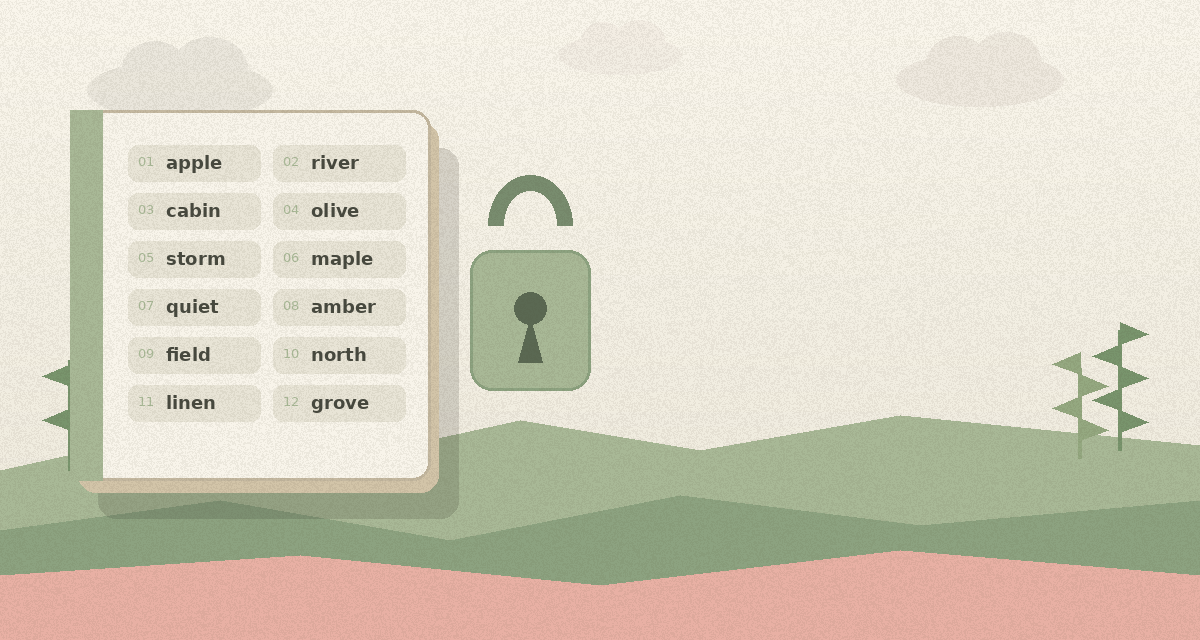
The words on the illustration at the top of this page — apple, river, cabin and so on — are a fake example only. Never enter a phrase you have seen published anywhere, and never treat a demo list as a wallet you can use.
How to store it safely
The common approach is boring and offline: write the words on paper, or stamp them into a metal backup plate that survives fire and water, and keep that somewhere private. Some people split copies across two secure locations so a single accident does not lose everything.
- No screenshots or photos — phone galleries usually sync to the cloud.
- No cloud notes, email drafts, chat messages or shared documents.
- No website form, "wallet validation" page, or support chat — those are theft, every time.
Hardware wallets keep the keys on the device itself and sign transactions there, so the phrase only ever appears during setup or recovery. Our crypto wallets guide and Bitcoin wallet guide explain the wallet types, and our crypto security best practices page covers the habits around them. There is more on how we think about security on our security page.
What happens if you lose it
If the phrase is gone and the device is gone, the coins in that self-custody wallet are generally unrecoverable. There is no reset password link, no bank recall, and no support desk anywhere that can rebuild your keys — not the wallet developer, not an exchange, not us. The coins still exist on-chain; nobody can move them.
The mirror image is just as important: if someone else copies your phrase, they can empty the wallet at any time, quietly, and on-chain transfers cannot be reversed. A phrase that has ever been photographed, typed into a website, or shown to another person should be treated as compromised, with funds moved to a freshly created wallet.
Seed phrases in Australia
Australia has a specific, well-documented scam pattern around recovery phrases. Scamwatch (run by the ACCC), together with police and cyber-security agencies, has warned about criminals impersonating the Australian Federal Police and digital currency exchange support staff. The call sounds official, sometimes referencing a fake ReportCyber report or a supposed investigation into your account, and it ends with a request to hand over your seed phrase or to move your coins to a "safe" or "cold storage" wallet the caller controls.
Legitimate police and legitimate exchanges never ask for a seed phrase. Read the Scamwatch alert on police and digital currency exchange impersonation, and our Australian crypto scams guide for the other patterns that show up locally.
The second Australian angle is custody. Coins left on a platform are platform custody: you hold an account balance — effectively an IOU with that business — protected by your login and two-factor authentication, and the business holds the keys. Businesses providing virtual asset designated services in Australia must register with AUSTRAC and run identity checks. That registration is an anti-money-laundering requirement — it is not an Australian financial services licence and it is not a quality stamp.
Coins you withdraw to a wallet you control are self-custody. Nobody can freeze them and nobody can restore them; the seed phrase is the entire protection. Neither option is universally "safer" — they fail in different ways, and which trade-off suits you is your decision. This is general information, not financial advice.
Frequently Asked Questions
What is a seed phrase?
A seed phrase — also called a recovery phrase or mnemonic — is a list of ordinary words, usually 12 or 24 of them, that a crypto wallet shows you when you first set it up. Those words encode the information needed to recreate the wallet and its private keys on any compatible wallet app or hardware device.
Is a seed phrase the same as a password?
No. A password protects an account that someone else runs, and it can be reset. A seed phrase is the key material itself. Nobody stores a copy for you and nobody can reset it, so anyone who reads your phrase can move your coins without needing your device or your PIN.
How many words is a seed phrase?
Most wallets use the BIP39 standard and generate 12 or 24 words from a fixed 2048-word list. A 24-word phrase carries more entropy than a 12-word phrase; both are considered impractical to guess. Word order matters, and the words must be written exactly as shown.
Can I recover my crypto if I lose my seed phrase?
If the wallet is self-custody and you have lost both the phrase and access to the device, the funds are generally unrecoverable. There is no password reset, no bank recall and no support desk that can restore the keys. This is why an offline backup is made before any funds are sent to the wallet.
Should I ever share my seed phrase with support or police?
No. Legitimate police and legitimate exchanges never ask for a seed phrase. Scamwatch has warned about criminals impersonating the AFP and digital currency exchange support staff, sometimes referencing fake ReportCyber reports, who then ask victims for a recovery phrase or to move coins to a "safe" wallet. Hang up and contact the organisation through a number you find yourself.
What is the difference between keeping crypto on an Australian exchange and using a seed phrase wallet?
Coins held on a platform are platform custody: the business holds the keys and you hold an account balance, protected by your email, password and two-factor authentication. Businesses providing virtual asset services in Australia must register with AUSTRAC, which is an anti-money-laundering requirement — not an AFSL and not a quality stamp. Coins withdrawn to a wallet you control are self-custody, and the seed phrase is the only thing protecting them.
How should I store a seed phrase?
Offline. People typically write the words on paper or stamp them into a metal backup plate, then store that somewhere private and protected from fire and water. Avoid photos, cloud notes, password managers you do not control, email, chat and any website form. Never type the words into a page that asks you to "validate" or "sync" a wallet.
Related Guides
Best Crypto Wallets Australia 2025 | Hot & Cold Wallet Guide
Compare the best crypto wallets in Australia for 2025. Reviews of hot wallets, cold storage, and hardware wallets for Australian beginners.

Bitcoin Rewards Australia: How Aussies Earn BTC in 2026
How Australians earn BTC through cashback cards, apps, browsers, referrals and exchange programs, plus custody checks, ATO tax basics and Jittie’s learn-and-earn education.

Crypto Staking Australia: 2026 Education Guide
Crypto staking in Australia explained for 2026: how proof-of-stake rewards work, liquid vs locked vs exchange earn products, ATO income vs CGT treatment, and the main risks. Education only.
Jittie Editorial Team
Crypto Education Specialists
Our team of crypto experts and financial educators are passionate about making cryptocurrency accessible to all Australians. With backgrounds in blockchain technology, finance, and education, we create clear, accurate guides to help you navigate the crypto world safely.