What Is a Smart Contract? Australia 2026 Guide
A plain-English Australia 2026 glossary for smart contracts: code that runs on a blockchain when conditions are met; how they differ from traditional contracts and from blockchain itself; history, types, platforms, use cases, benefits, limits, legal caveats and Australian rules. Education only — not financial or legal advice.
Quick Answer
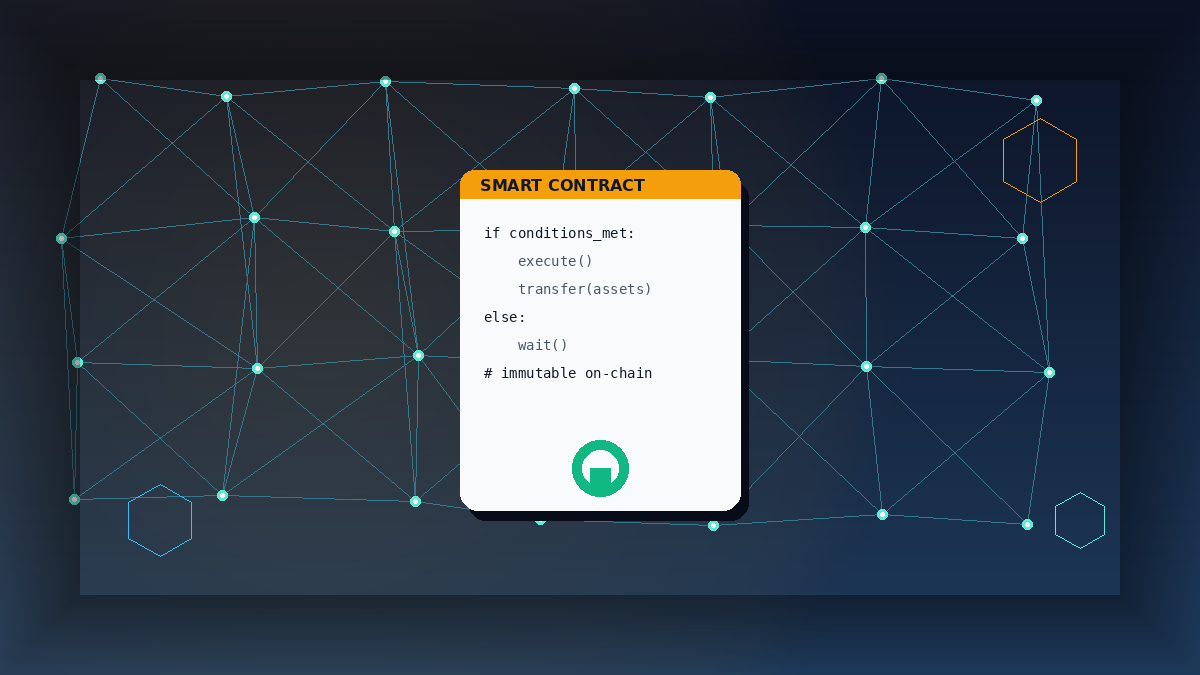
A smart contract is a computer program stored on a blockchain that automatically runs when pre-defined conditions are met — often described as “if this, then that” logic living on a shared ledger. Once deployed, many contracts execute without a human clerk checking each step; the network records the outcome. Smart contracts are not the same as “blockchain” (the ledger), not the same as “DeFi” (apps built with contracts), and not a guarantee that code equals Australian law or that outcomes are fair. They can automate transfers and agreements — and they can also encode bugs, rely on faulty external data (oracles), or produce irreversible results you cannot charge back. In Australia, exchanging crypto for AUD generally needs AUSTRAC VASP/DCE registration; ASIC publishes guidance on when digital assets are financial products. Code is not automatically “law.” Education only — not financial or legal advice.
Smart contracts in one screen
On-chain if-then code
Model
Programmable blockchains
Runs on
Auto-executes; limited recourse
Vs paper
Bugs / oracles / irreversibility
Risk
TL;DR - Quick Takeaways
- A smart contract is a program on a blockchain that runs when pre-defined conditions are met
- It is not the same as blockchain (the ledger), DeFi (apps built with contracts), or Web3 (broader era label)
- Differs from traditional contracts: more automation and irreversibility; code is not automatically Australian law
- History: Szabo’s concept → limited Bitcoin scripts → Ethereum popularised general-purpose contracts
- Lifecycle: write/test → deploy bytecode → users call functions → network executes → state updates
- Types range from escrows and tokens to DeFi suites, NFTs, governance and oracle-dependent apps
- Platforms/tools: Ethereum and others, wallets, explorers, auditors — tools do not equal safety
- Use cases: DeFi, supply-chain pilots, insurance experiments, tokenisation — maturity varies
- Benefits claimed: automation, transparency, fewer middle steps — none mean “safe”
- Limits: bugs, upgrades, oracles, gas, UX, irreversible mistakes, legal mismatch
- Australia: AUSTRAC VASP/DCE for crypto↔AUD; ASIC digital-asset guidance; familiar bank dispute rails often absent
- Future is uncertain — better tooling and clearer rules possible; hype is not inevitability
- Education only — join the waitlist for Jittie launch updates (no live card rates on this page)
Table of Contents
What a smart contract actually means
A smart contract is software published to a blockchain that runs when its conditions are met. In plain English: you (or a developer) write rules such as “if Alice deposits X and Bob confirms Y, then send Z.” After the code is deployed, the network can execute those rules without a bank clerk or solicitor clicking “approve” on every step. The blockchain records that the function ran and what state changed.
That sounds like a legal contract with a robot attached — and marketing often leans on that metaphor. It is still a metaphor. A smart contract is code. Whether it creates enforceable rights under Australian law depends on facts: what the parties agreed, what the code does, and how courts and regulators treat the arrangement. “Smart” does not mean wise, fair, or bug-free. “Contract” does not automatically mean a solicitor-drafted agreement that a court will rewrite if something goes wrong.
This glossary sits beside sibling pages. Blockchain is the shared ledger idea. Ethereum is a major programmable network where many contracts live. Web3 is a broader ownership-era internet label. DeFi is the finance-app category built largely from smart contracts. Stablecoins are tokens that often move through contracts. This page explains the code layer itself — not a buy funnel and not a DeFi product tour.
Smart contracts vs blockchain
Blockchain is the shared, append-only ledger that networks of computers agree on. It stores transactions and (on programmable chains) contract code and state. A smart contract is one kind of thing that can live on that ledger: a program with an address, functions and storage.
You can have a blockchain with almost no smart contracts (Bitcoin’s scripting is deliberately limited compared with Ethereum’s). You can also talk about smart contracts without understanding every consensus detail — but you cannot run a typical public smart contract without some underlying chain. Confusing the two leads to bad questions: “Is blockchain safe?” is different from “Is this particular contract audited and who can upgrade it?”
Think of blockchain as the operating environment and smart contracts as apps (with the caveat that apps here are often immutable or hard to patch once live). For the ledger concept in depth, read What Is Blockchain. For the chain that popularised general-purpose contracts, read What Is Ethereum.
A short history
The phrase “smart contract” is widely credited to computer scientist Nick Szabo in the 1990s — long before Bitcoin. Szabo described digital agreements that could execute themselves when conditions were met, using the classic vending-machine analogy: insert money, select item, machine dispenses; the mechanism enforces the deal without a cashier negotiating each sale.
Bitcoin (2009) introduced a blockchain with a constrained scripting language. It can express limited conditions (for example multi-signature spends) but was not designed as a general application platform. Ethereum (launched 2015) popularised Turing-complete smart contracts: developers could deploy richer programs (commonly written in Solidity) that other users call with transactions. Token standards, decentralised exchanges, lending protocols and NFTs grew from that model. Other chains and layer-2 networks later competed on fees, speed and tooling.
History matters because hype cycles recycle the same promises. Automation is real; so are multi-million-dollar exploits when code or economic design fails. Treat “smart contracts will replace lawyers” the way you treat any sweeping tech slogan — check what actually runs, who can change it, and what happens on failure.
How smart contracts work
At a high level the lifecycle looks like this:
1. Write and test. Developers write source code, often in Solidity (Ethereum) or another chain’s language. Tests and audits reduce — but never eliminate — risk.
2. Deploy. A special transaction publishes the bytecode to the network. The contract receives an address. Deployment costs network fees (“gas”).
3. Interact. Users (or other contracts) send transactions that call functions: deposit, swap, vote, mint. Each call must satisfy the contract’s checks and pay fees.
4. Execute and record. Network validators execute the code. If execution succeeds, state updates (balances, ownership, flags) are recorded on-chain. If it reverts, typically nothing changes except fees spent.
5. Observe. Explorers show the code (if verified), transactions and events. Transparency helps researchers; it does not mean every retail user can read bytecode safely.
Conditional logic is the core idea: if collateral ratio falls below a threshold, liquidate; if a vote passes, unlock a treasury transfer; if a payment arrives before a deadline, release goods (in a simplified escrow). Many useful contracts also need oracles — external data feeds for prices, weather, sports results or identity attestations. If the oracle is wrong, the contract can execute “correctly” relative to bad inputs.
Irreversibility is the practical punchline. Once a transaction confirms, there is usually no bank-style chargeback. A bug that drains a pool, a mistaken address, or a malicious token approval can mean permanent loss. Self-custody wallets and How Does Crypto Work cover keys; this page focuses on why the code layer itself is unforgiving.
Types of smart contracts
There is no single official taxonomy, but these buckets help:
Simple conditional payments and escrows. Hold funds until a condition or multi-sig approval releases them.
Token contracts. Fungible tokens (for example ERC-20 style) and non-fungible tokens (NFTs) that define balances, transfers and metadata rules.
DeFi protocol contracts. Lending pools, automated market makers, derivatives and aggregators — often many contracts working together. See What Is DeFi for the application category; this page does not re-teach yield products.
Governance and DAO modules. Voting, treasuries and proposal execution. Note that governance contracts can still be controlled by small multisigs or vulnerable to low turnout.
Oracle-dependent and cross-chain contracts. Bridges and apps that trust external messages. Historically frequent exploit targets.
Upgradeable vs immutable. Some contracts are designed never to change; others use proxy patterns so admins can swap logic. Upgradeability can fix bugs — and can also let a compromised key rewrite the rules. Always ask: who holds the upgrade keys?
Platforms and tools
Ethereum remains the reference environment many Australians hear about first: Solidity, the Ethereum Virtual Machine (EVM), wallets such as browser extensions or hardware devices, and explorers such as Etherscan-style sites. Other EVM-compatible chains and non-EVM ecosystems compete on cost and throughput. Layer-2 networks settle batches to a parent chain to cut fees — adding their own trust assumptions.
Tooling includes compilers, local test networks, security analysers, formal verification experiments and professional audit firms. Audits are useful signals, not warranties. A green badge on a website is not a guarantee. Front-end websites are ordinary web apps that ask your wallet to sign; a cloned UI can target a real contract address or a malicious one. Always verify URLs and approval scopes.
For programmable-chain context read What Is Ethereum. For wallet and key basics read How Does Crypto Work and What Is a Crypto Wallet.
Real-world use cases
Decentralised finance. Lending, swapping and liquidity provision are the largest public examples. Outcomes and risks vary; advertised APYs are not guarantees. See What Is DeFi.
Supply chain and provenance pilots. Recording shipment events or certificates on-chain. Many pilots still rely on humans and companies to enter truthful data — the contract cannot know if a sensor was spoofed.
Insurance-like experiments. Parametric payouts when an oracle reports a trigger (for example flight delay). Oracle and basis risk remain.
Tokenised assets and settlements. Experiments in moving representations of funds or rights on-chain. Legal wrapping and custody usually still matter off-chain.
NFTs and digital collectibles. Ownership records enforced by token contracts — distinct from copyright law automatically transferring.
Identity and credentials experiments. Attestations and access control. Privacy and regulatory questions are non-trivial.
Use cases prove that automation is useful. They do not prove every deployment is ready for retail money or that Australian consumer protections mirror a bank product. If you are exploring rewards-style education that sits beside Bitcoin rails, the Bitcoin Rewards Australia guide explains concepts in pre-launch framing — join the waitlist for Jittie updates rather than treating any card terms as live.
Benefits and limitations
Claimed benefits. Automation runs when conditions hit, at network speed, without waiting for business hours. Transparency of verified source and public state helps investigation for those who can read them. Some flows remove a traditional intermediary — shifting trust onto code, validators, oracles and front-ends instead. Composability lets contracts call contracts, enabling complex apps — and cascading failures.
Limitations and risks (read twice). Bugs and economic design flaws still drain pools after audits. Oracle failures produce “correct” execution on bad inputs. Irreversible transactions make mistaken addresses and malicious approvals expensive. Upgrade and admin keys can hide privileged control behind a decentralised label. Legal mismatch means code may not match the parties’ understanding. Gas spikes, confusing approvals and phishing thrive where irreversible actions meet FOMO. Regulatory classification of a token or service can be fact-specific.
None of the benefits mean “safe,” “suitable for you,” or “enforceable in every Australian court the way you hope.” Fake support agents and cloned front-ends remain common. Never enter a seed phrase into a website. The Australian crypto scams guide covers warning signs and reporting steps.
Legal and regulatory considerations (Australia)
Two separate frames matter.
First, code is not automatically law. A smart contract can move tokens when its conditions fire. Whether that creates, modifies or discharges contractual rights under Australian law depends on agreement, conduct and statute — not on the marketing word “contract.” Parties sometimes intend the code to be the whole deal; sometimes the code is only a settlement mechanism beside a written agreement. Disputes can be messy when the code does something nobody quite expected. Do not assume a court will reverse an on-chain transfer the way a bank might investigate a mistaken payment.
Second, regulated crypto activity. If a platform exchanges cryptocurrency for Australian dollars, it generally needs AUSTRAC registration as a virtual asset service provider (VASP), historically discussed as a digital currency exchange (DCE). That is anti-money-laundering registration — not an Australian financial services licence and not a stamp that a smart contract is safe. ASIC’s digital-assets guidance explains why financial-product obligations turn on a product’s rights and operation, not a smart-contract label.
Eagle BTM Pty Ltd ACN 659 281 820 publishes this education site and is an AUSTRAC-registered DCE/VASP. AUSTRAC registration is not an AFSL. On-chain smart-contract actions are often irreversible and may sit outside familiar banking dispute schemes. Factor that into any personal decision. This guide is education only — not legal, tax or financial advice.
Curious about Jittie? We are in pre-launch. The planned product is merchant-funded Bitcoin back on everyday spend once live. Join the waitlist for launch updates. This guide stays education-only and does not publish live card rates.
Future of smart contracts (honest)
Better languages, account abstraction, clearer wallet warnings and formal methods may reduce some foot-guns — if widely adopted. Clearer regulation could protect consumers and also constrain designs offered to Australians. Institutional tokenisation may grow in controlled environments beside permissionless experiments. AI and IoT integration appear often in forecasts; each adds new oracle and security surfaces rather than magically deleting risk.
Honest bottom line: smart contracts are real infrastructure used at scale, and they remain easy to get badly wrong. It is not inevitable that they replace traditional contracts or banks. Evaluate claims against primary docs, audits, privilege maps and official Australian guidance — not social media certainty.
How to get started (high-level)
If smart contracts still feel abstract, start with foundations rather than depositing into a protocol:
- Understand the ledger on What Is Blockchain.
- Learn wallets, keys and custody on How Does Crypto Work and What Is a Crypto Wallet.
- For the major programmable environment, read What Is Ethereum.
- For apps built from contracts, read What Is DeFi and What Is Web3.
- For pegged tokens often moved by contracts, read What Is a Stablecoin.
- If you later use a service that converts crypto and AUD, check AUSTRAC registration and ASIC guidance — not social proof.
This page is not a buy funnel. There is no call to purchase a token or treat any card rate as live. Education first; join the waitlist if you want Jittie launch news. This is education only, not financial advice.
Frequently Asked Questions
What is a smart contract in simple terms?
A smart contract is a computer program stored on a blockchain that automatically runs when its conditions are met — often summarised as “if this, then that” logic on a shared ledger. It can move tokens or update state without a human clerk approving every step, but it is still code, not a guarantee of fairness or legal enforceability.
How is a smart contract different from blockchain?
Blockchain is the shared ledger that records transactions and (on programmable networks) contract code. A smart contract is one kind of program that can live on that ledger. You can have a chain with limited scripting, and you can misunderstand risk if you treat “blockchain” and “this contract” as the same question.
Are smart contracts the same as traditional legal contracts?
Not automatically. Smart contracts automate execution when coded conditions fire. Whether they create enforceable rights under Australian law depends on the parties’ agreement, conduct and statute. Courts may not “fix” bytecode the way they reform a paper contract, and confirmed on-chain actions are often irreversible.
How do smart contracts work?
Developers write and test code, deploy it to a network (paying fees), then users or other contracts call functions. The network executes the logic and records state changes. Many apps also rely on oracles for off-chain data such as prices. Mistakes and malicious approvals can be permanent.
What are common types of smart contracts?
Simple escrows, fungible and non-fungible token contracts, DeFi lending and exchange protocols, NFT marketplaces, governance/DAO modules, and oracle-dependent or cross-chain systems. Some are immutable; others use upgrade proxies controlled by admin keys.
Which platforms run smart contracts?
Ethereum popularised general-purpose contracts (often written in Solidity). Other programmable chains and layer-2 networks compete on fees and speed. Wallets, explorers and audit tools support development and inspection — none of them make a contract safe by themselves.
What are the main risks?
Bugs and economic design flaws, oracle failures, irreversible transactions, compromised upgrade keys, phishing and fake front-ends, and a mismatch between what code does and what people thought they agreed. Audits reduce but do not eliminate risk. Never enter a seed phrase into a website.
How does Australia treat smart contracts and crypto platforms?
Exchanging crypto for AUD typically requires AUSTRAC VASP/DCE registration. ASIC publishes guidance on when digital assets are financial products. Code is not automatically law, and many on-chain actions sit outside familiar banking dispute schemes. Education only — not legal or financial advice.
Does Jittie run a live rewards card today?
Jittie is in pre-launch. The planned product uses merchant-funded Bitcoin back once live. Join the waitlist. No live rates appear on this page.
Related Guides

Bitcoin Rewards Australia: How Aussies Earn BTC in 2026
How Australians earn BTC through cashback cards, apps, browsers, referrals and exchange programs, plus custody checks, ATO tax basics and Jittie’s learn-and-earn education.

Crypto Staking Australia: 2026 Education Guide
Crypto staking in Australia explained for 2026: how proof-of-stake rewards work, liquid vs locked vs exchange earn products, ATO income vs CGT treatment, and the main risks. Education only.
What Is a Crypto Exchange in Australia? 2026 Guide
What a crypto exchange is in Australia, how AUSTRAC registration works, how AUD on-ramps work, and how a centralised exchange differs from a DEX, a Bitcoin ATM and an ASX bitcoin ETF.
Jittie Editorial Team
Crypto Education Specialists
Our team of crypto experts and financial educators are passionate about making cryptocurrency accessible to all Australians. With backgrounds in blockchain technology, finance, and education, we create clear, accurate guides to help you navigate the crypto world safely.