How Does Crypto Work? A 2026 Guide for Australians
Cryptocurrency explained without the jargon fog: where coins actually live, what wallets and keys do, how a transaction gets confirmed, and what Australians should understand before buying or holding. Education only — not financial advice.
Quick Answer
Cryptocurrency is digital value recorded on a shared public ledger (usually a blockchain) that many computers keep in sync. Your coins are not files inside an app — they are ledger entries. A wallet stores the cryptographic keys that prove you control an address and lets you sign transactions. When you send crypto, your wallet builds and signs an instruction, the network checks it, and miners or validators add it to a new block. Confirmations stack on top of that block until reversing the transfer becomes impractical. Networks use different rules (proof of work or proof of stake) to agree on the next block. In Australia, buying with AUD usually means an AUSTRAC-registered virtual asset service provider, and crypto you hold directly is generally treated as a CGT asset. Education only.
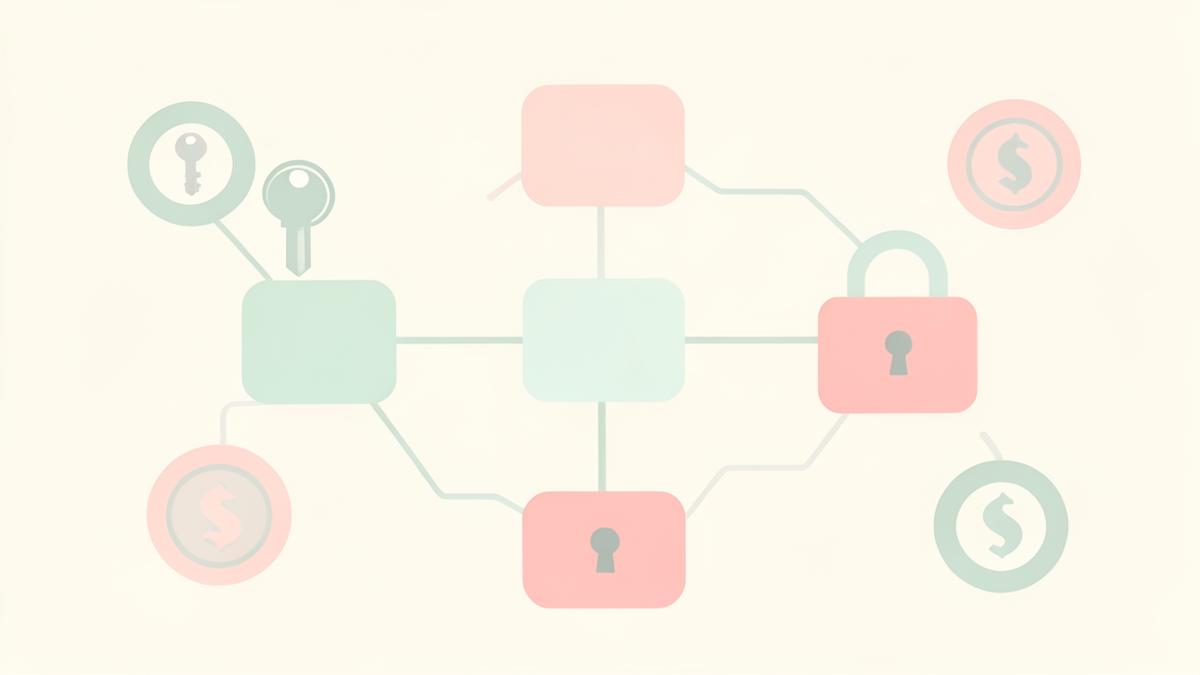
Crypto in one screen
Blockchain
Shared ledger
Private keys
Control
Signed transaction
Send
CGT asset
AU tax starting point
TL;DR - Quick Takeaways
- Crypto balances live on a shared ledger; a wallet holds keys, not a pile of coin files
- A public address receives funds; a private key (and seed phrase) authorises spending
- Sending crypto means signing a transaction the network verifies and records in a block
- Proof of work (e.g. Bitcoin mining) and proof of stake (e.g. Ethereum validators) are two common ways networks agree
- Fees pay the network; more confirmations mean harder to reverse
- Australians usually buy with AUD on an AUSTRAC-registered platform, then choose custody
- Education only — not financial, tax or legal advice
Table of Contents
The big misconception: crypto is not "in" your wallet
Most beginner confusion starts in the wrong place. People ask which coin to buy before they understand where the value actually sits. The mental model that fixes almost everything else is simple: a shared ledger records who can spend what, and the app on your phone is just a window onto that ledger. There is no coin file travelling around, no digital object sitting in a folder, and nothing physically moving between two handsets when you hit send.
So when you "have" Bitcoin or ether, one of two things is true. Either you control an address on that ledger, because you hold the secret key that can authorise spending from it, or you hold a claim against a business — an exchange or platform that controls the keys on your behalf and shows you a number in its own system. Both are normal. They are just very different in terms of who is responsible when something goes wrong.
If the vocabulary is new, our plain explainers on what a crypto wallet is and what a seed phrase is pair well with this page.
What a blockchain actually is
A blockchain is a shared notebook that many independent computers each keep a full copy of. New transactions are collected and batched into blocks, and every block carries a cryptographic fingerprint of the block before it. That chaining is the whole trick. To quietly rewrite an old entry you would have to redo the work — or the stake — that secured that block and every block after it, faster than the rest of the honest network is adding new ones. In practice, the wider network simply rejects the rewritten version.
That is what people mean when they say the record is tamper-evident. It is worth being precise about what the claim covers. The design makes silent edits to settled history extremely hard. It does not make any particular coin project safe, useful, well-run or worth money, and it does not protect you from signing a transaction you should not have signed. Strong ledger, ordinary human risk.
The Bitcoin project's own how it works page is a good primary source if you want the original framing rather than a second-hand summary.
Keys, addresses and wallets
Three terms carry most of the weight, and they are genuinely worth learning properly.
- Public address. A long string you can safely share. It is where people send funds, and anyone can look up its balance and history on a public block explorer.
- Private key. The secret that signs spending instructions. Whoever holds it can move the funds. It should never be typed into a website, a chat window or a support form.
- Seed phrase. A human-readable backup of that key material, usually 12 or 24 ordinary words in a fixed order. Anyone with the seed can recreate the wallet on any device, anywhere in the world.
A self-custody wallet, then, is not a container full of coins. It is key management software with a friendly interface: it generates keys, keeps them out of reach, shows your ledger balance, and signs transactions when you approve them. There is no "forgot password" link behind it. Lose the seed and the coins remain visible on the ledger forever while nobody can authorise a spend.
Custodial exchange accounts work the other way around: the business holds the keys, runs its own internal record of your balance, and can reset your login. That convenience is real, and so is the dependency. Because seed phrases are the single most targeted thing in crypto, it is worth reading our Australian crypto scams guide before you ever set one up.
Follow one transaction start to finish
Watching a single payment travel through the system makes the whole model click:
- You paste in the recipient's address and enter an amount.
- Your wallet builds an instruction that says, in effect, move this amount from my address to theirs, and attaches a fee.
- The wallet signs that instruction with your private key. In a well-designed wallet the key itself never leaves the device — only the signature does.
- The signed transaction is broadcast to the network and relayed between nodes.
- Nodes check the maths: is the signature valid for that address, and are the funds actually available and not already spent?
- A miner or validator includes it in the next block they produce.
- Each subsequent block adds a confirmation, and the transfer becomes steadily harder to undo.
Nothing physical flies between phones, and no bank sits in the middle approving you. The ledger is simply updated, everywhere, to say a different address now controls that value. Once the transaction is deeply confirmed it is effectively irreversible — which is a feature when you are being paid and a disaster when you have fat-fingered an address.
How networks agree (proof of work and proof of stake)
If thousands of computers each keep a copy of the ledger, something has to decide whose version of the next block counts. That mechanism is called consensus, and two approaches dominate.
Proof of work is what Bitcoin uses. Miners run enormous numbers of calculations, spending real computing power and electricity, competing to produce a valid block and claim the reward. The cost of that effort is the security: rewriting history would mean out-spending the entire honest network.
Proof of stake is what Ethereum moved to with The Merge in September 2022. Instead of burning energy, validators lock up collateral and are selected to propose and attest to blocks. Misbehave and part of that stake can be destroyed. If you want the mechanics of participating, our Australian staking guide goes further than we will here.
Both are answers to the same question: how does a network with no boss agree on one shared history? They trade off differently on energy use, hardware costs and how value concentrates, and reasonable people argue about which is healthier long term.
Fees, confirmations and different chains
Fees pay the operators who secure the network and give them a reason to include your transaction rather than someone else's. On Bitcoin this is a straightforward fee market: block space is limited, so when demand spikes the price of getting in quickly rises. On Ethereum the same idea is called gas, and it is priced per unit of computation — which is why a simple transfer costs far less than a complex interaction. Our Ethereum gas explainer unpacks that pricing in detail.
Confirmations are simply the number of blocks stacked on top of the one containing your transaction. One confirmation means it is recorded; several mean reversing it has become impractical. Different platforms wait for different numbers before they credit you, which is why a transfer can show as sent on one screen and pending on another.
Worth saying plainly: different chains are separate ledgers, not branches of one system. Each makes its own trade-offs between speed, cost and security, and each has its own address formats and rules. Sending an asset over the wrong network — right-looking address, wrong chain — is one of the most common irreversible mistakes beginners make. Always match the network on both ends before confirming.
Bitcoin, altcoins and other crypto types
Bitcoin came first and remains the largest by a wide margin, which is why it is usually the reference point everything else gets compared against. Every other cryptocurrency is loosely grouped as an altcoin, which is a category so broad it tells you almost nothing on its own — it covers serious infrastructure networks and throwaway meme tokens alike.
A third group worth knowing is stablecoins, which aim to track the value of a currency such as the US dollar rather than float freely. They are widely used for moving value between platforms, and the important question with any of them is what actually backs the peg and who audits it. We cover those differences separately in our stablecoin comparison. For this page the point is only that "crypto" is not one asset with one risk profile.
What this means in Australia
Buying with AUD. Businesses that exchange crypto for Australian dollars must be registered with AUSTRAC as a virtual asset service provider, the category previously called a digital currency exchange. Read that registration correctly: it is an anti-money-laundering obligation, not an Australian financial services licence, and not a quality stamp on the business. Our Australian exchange guide explains what to compare beyond the register.
Tax. Crypto you hold directly is generally treated as a CGT asset. Selling for dollars, swapping one coin for another, and spending crypto on goods can each be a disposal you need to record, even when no Australian dollars hit your bank account. The ATO's crypto asset investments guidance is the primary source, and our plain-English tax overview walks through the record keeping.
Custody and scams. Leaving coins on a platform means holding an IOU from that business; withdrawing to your own wallet means holding the keys and the responsibility. Whichever you choose, Scamwatch reports a steady stream of fake support accounts and "wallet verification" pages asking for seed phrases. No legitimate exchange, wallet or government agency will ever ask for yours.
How Australians typically get started
This is the shape of it, not a tutorial and not a prompt to act:
- Check the provider on AUSTRAC's public register.
- Open an account and complete KYC identity checks.
- Deposit Australian dollars, usually by PayID or bank transfer.
- Buy, understanding whether you are paying a spread or a stated fee.
- Decide whether to leave the coins in platform custody or self-custody them.
- Send a small test transaction first if you are withdrawing for the first time.
- Keep records of every buy, sell, swap and transfer for tax time.
If you want the practical view alongside this explainer, we keep a plain Bitcoin page, a live BTC price page and a step-by-step how to buy Bitcoin in Australia guide.
Risks to understand first
- Volatility. Prices move sharply in both directions, around the clock, with no circuit breakers.
- Irreversible sends. A confirmed transfer to the wrong address has no chargeback and no support desk.
- Phishing and seed-phrase scams. Fake apps, lookalike domains and "verify your wallet" prompts are the most common way Australians lose funds.
- Platform custody risk. While coins sit on an exchange you are relying on that business staying solvent and secure.
- Wrong-network sends. The same-looking address on a different chain can mean permanently unrecoverable funds.
- Project failure. Most coins launched in any given year fade. A working blockchain does not imply a durable project.
- Misreading AUSTRAC. Registration is an AML requirement. It implies nothing about an AFSL, consumer protection or the safety of your funds.
Frequently Asked Questions
How does cryptocurrency work in simple terms?
A cryptocurrency network is a shared public ledger that thousands of independent computers keep in sync. The ledger records which addresses can spend what. You control an address using a private key held by your wallet software or hardware. To move value you sign a transaction with that key, the network checks the signature and that the funds have not already been spent, and the transaction is bundled into a block. Later blocks stack on top as confirmations, making the record progressively harder to change.
Where is my crypto stored?
Your crypto is not a file stored inside an app on your phone. The balance exists as entries on the network ledger, and copies of that ledger live on computers around the world. What your wallet stores is the private key that proves you control a particular address. That is why losing a seed phrase can mean losing access permanently — the coins still exist on the ledger, but nobody can authorise a spend from that address.
What is the difference between a wallet and an exchange account?
A self-custody wallet holds keys you control, so you sign your own transactions and you alone are responsible for backups. An exchange or platform account is custodial: the business holds the keys and shows you a balance in its system, much like a bank statement. Custodial accounts add convenience and password recovery, but you are relying on that business to remain solvent, secure and operational.
What is proof of work vs proof of stake?
Both are methods for a decentralised network to agree on the next block without a central authority. In proof of work, used by Bitcoin, miners spend computing power and electricity competing to produce a valid block. In proof of stake, used by Ethereum since The Merge in September 2022, validators lock up collateral and are selected to propose and attest to blocks, losing part of that stake if they behave dishonestly.
Are crypto transactions reversible?
Generally no. Once a transaction is confirmed in a block and further blocks have stacked on top, there is no chargeback process and no support desk that can claw it back. Sending to a wrong address, or sending an asset over the wrong network, usually means the funds are gone. This is why a small test transaction before a large transfer is common practice.
Is crypto legal in Australia?
Yes. Australians can legally buy, hold, sell and transfer crypto. Businesses that exchange virtual assets for money must register with AUSTRAC as a virtual asset service provider, previously called a digital currency exchange. That registration is an anti-money-laundering and counter-terrorism-financing requirement. It is not an Australian financial services licence and it is not a quality or safety endorsement of the business.
How does the ATO treat cryptocurrency?
Crypto held directly by an individual is generally treated as a capital gains tax asset in Australia. Selling for Australian dollars, swapping one coin for another, or spending crypto on goods can each be a disposal with a CGT consequence. Some activity, such as certain rewards or business-like trading, can be treated as income instead. This is general information — check current ATO guidance or speak to a registered tax agent, and keep records of dates, amounts and AUD values.
Related Guides

Bitcoin Rewards Australia: How Aussies Earn BTC in 2026
How Australians earn BTC through cashback cards, apps, browsers, referrals and exchange programs, plus custody checks, ATO tax basics and Jittie’s learn-and-earn education.

Crypto Staking Australia: 2026 Education Guide
Crypto staking in Australia explained for 2026: how proof-of-stake rewards work, liquid vs locked vs exchange earn products, ATO income vs CGT treatment, and the main risks. Education only.

What Is a Crypto Exchange in Australia? 2026 Guide
What a crypto exchange is in Australia, how AUSTRAC registration works, how AUD on-ramps work, and how a centralised exchange differs from a DEX, a Bitcoin ATM and an ASX bitcoin ETF.
Jittie Editorial Team
Crypto Education Specialists
Our team of crypto experts and financial educators are passionate about making cryptocurrency accessible to all Australians. With backgrounds in blockchain technology, finance, and education, we create clear, accurate guides to help you navigate the crypto world safely.