What Is a Bull Market? Australia 2026 Crypto Guide
A plain-English Australia 2026 glossary for the term bull market: what it means, where the 20 percent rule comes from, how a bull market differs from a bear market, a rally, a bubble and altseason, what the 2017, 2020–21 and 2024 crypto bull runs looked like, and the Australian details most explainers skip. Education only — not financial or tax advice.
Quick Answer
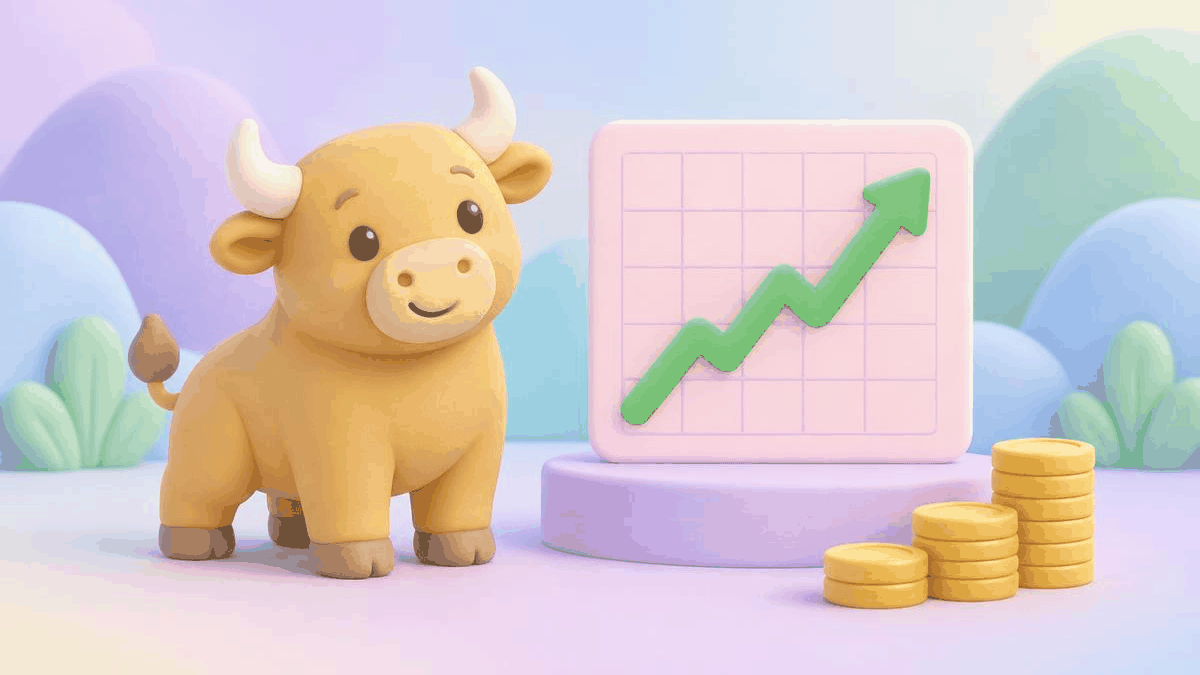
A bull market is a sustained, broad rise in prices, usually with confident sentiment, that lasts long enough to feel like the new normal rather than a bounce. In share markets the common rule of thumb is a rise of 20 percent or more from a recent low, typically measured on a broad index such as the S&P/ASX 200. Crypto borrows the term but uses it more loosely, because Bitcoin and other coins can move 20 percent without the trend changing. Crypto’s best-known bull runs peaked in late 2017 and late 2021, and Bitcoin moved above its previous high again in 2024. The opposite is a bear market. A bull market describes what prices have done; it is not a forecast, a timetable, or a signal to buy or sell.
Bull markets in one screen
A long, broad price rise
Means
20%+ up from a recent low
Rule of thumb
2017, 2020–21, 2024
Crypto examples
A forecast or advice
Not
TL;DR - Quick Takeaways
- A bull market is a sustained, broad rise in prices with confident sentiment, not a single green day
- The common share-market shorthand is a rise of 20 percent or more from a recent low
- Crypto uses the label more loosely, because 20 percent swings happen inside every kind of trend
- A bear market is the mirror image: a sustained, broad fall with pessimistic sentiment
- Crypto’s best-known bull runs peaked in late 2017 and late 2021, and Bitcoin passed its old high again in 2024
- Bull markets tend to run hotter in crypto because of leverage, hype cycles and thin small-coin markets
- Nobody can reliably call the start, the top, or how long a bull market will last
- Selling at a gain is generally a CGT event in Australia; watching prices rise is not
- Rising markets attract scams promising to multiply your money — check ASIC Moneysmart and Scamwatch
- Education only — join the waitlist for Jittie launch updates
Table of Contents
What a bull market actually means
A bull market is a period when prices across a market rise a long way and keep rising, and most participants expect more of the same. Three ingredients usually travel together: a meaningful climb from a recent low, a climb that is broad rather than limited to one asset, and a mood that has turned from caution to confidence, and sometimes to excitement.
The word “market” matters. One coin doubling while the rest of crypto drifts is a good run for that coin, not a bull market. When people say crypto is in a bull market, they usually mean Bitcoin and most large coins have been rising together for months. When people say the Australian share market is in one, they usually mean a broad index such as the S&P/ASX 200 has climbed a long way from its low.
The word “sustained” matters too. Markets rise on good days all the time, including in the middle of long downtrends. A bull market is a regime, not an event: the backdrop against which bad news gets shrugged off, dips get bought, and people who sold early watch prices keep climbing without them.
The animal names are old trading slang. The image most people learn is a bull thrusting its horns upward while a bear swipes its paws downward. Being bullish now simply means expecting or experiencing rising prices, and a bull is someone who expects a market to go up.
The 20 percent rise rule of thumb
The most quoted shorthand comes from share markets: a rise of 20 percent or more from a recent low, usually on a broad index, is commonly treated as the start of a new bull market. It is the mirror of the bear-market rule, which looks for a fall of 20 percent or more from a recent high. US regulator education pages such as Investor.gov and Australian bank education pages describe bull and bear markets in these broad terms.
It is measured from the low, not from where you bought. The label describes the market, not your account. If you bought near the previous top, the market can be in a new bull market while you are still underwater.
It is measured on a broad index. For Australian shares that usually means the S&P/ASX 200. Crypto has no single agreed index, so people use Bitcoin’s price or the total market cap a data site reports, and different baskets can tell different stories on the same day.
Why crypto bends the rule. The 20 percent line was designed for share indexes that bundle hundreds of companies. Bitcoin can rise 20 percent in a few weeks in the middle of a downtrend, and smaller coins can do it in a day. So crypto watchers lean more on the other ingredients: how long prices have been rising, how many coins are rising together, whether dips keep getting bought, whether old highs are being broken, and whether money and attention are flowing in. Treat “up 20 percent” in a crypto headline as a starting point for questions, not a verdict.
A worked example, labelled as maths rather than a market reading: an index that bottomed at 100 and later traded at 124 would be 24 percent above its low and meet the usual rule of thumb. At 112 it would be 12 percent above its low, which most people would call a rally or a rebound rather than a new bull market. This page does not quote any live price or index level.
Bull vs bear market: the key differences
The two terms are mirror images, and most people search for them together. Our bear market guide covers the falling side in depth; here is how the two compare.
Direction. A bull market is a sustained rise; a bear market is a sustained fall. Both require the move to be broad and long-lasting, not a single asset or a single week.
Rule of thumb. A bull market is often dated from a rise of 20 percent or more off a recent low. A bear market is often dated from a fall of 20 percent or more off a recent high. Crypto uses both thresholds loosely.
Mood. Bull markets run on confidence and, late in the run, on fear of missing out (FOMO). Bear markets run on caution and, at their worst, on panic. Sentiment usually follows prices more than it leads them.
Behaviour. In a bull market, dips tend to get bought and bad news gets ignored. In a bear market, rallies tend to get sold and good news gets ignored. The same headline can move prices in opposite directions depending on which regime the market is in.
Risk. Both labels are easiest to apply looking back, and neither is a forecast. The obvious risk in a bear market is losing money as prices fall. The less obvious risk in a bull market is taking on more than you realise — more leverage, more concentration, smaller and riskier coins — because recent results make risk feel smaller than it is.
Bull market vs rally, bubble and altseason
These words get mixed up in headlines. They describe different things.
Rally. A short, sharp rise. Rallies happen inside bull markets and inside bear markets. A bear market rally can be large enough to feel like a new bull market, then fade and make new lows. One rally does not make a regime.
Bubble. A rise that runs far beyond what most people later judge the underlying value to be, fed by speculation and the expectation that someone else will pay more. Bubbles end in sharp falls. Some bull markets end as bubbles; many do not, and the label is usually only agreed afterwards.
Altseason. Crypto slang for a stretch when many altcoins rise faster than Bitcoin, often late in a crypto bull market. It has no official definition. People often watch bitcoin dominance — Bitcoin’s share of total crypto market value — for hints, because Bitcoin’s share tends to shrink when money rotates into smaller coins. A falling dominance number can also simply mean Bitcoin is falling less than the rest, so it is a clue, not a signal.
What a bull market usually looks like
Many explainers describe bull markets in phases. This is a loose description of how past bull markets have felt, not a model that tells you where you are today.
1. The doubt. Prices are climbing off a low, but sentiment is still gloomy after the previous bear market. Rises are dismissed as another false dawn. Volumes and media coverage are thin.
2. The broadening. More assets join the rise, old resistance levels give way and bad news stops pushing prices down. Larger investors and institutions often become more visible in this phase.
3. The excitement. Prices make new highs, media coverage returns, and friends and family who ignored the market start asking about it. In crypto, this is when new tokens launch quickly, smaller coins run hardest and leverage builds up.
4. The froth. Rises become vertical and stories replace reasons. People justify prices with “this time is different.” Scams multiply because attention is cheap.
The phases explain why the same market can feel ignored one year and unavoidable the next. They are not a timer, and the top is only obvious in hindsight.
Past crypto bull markets: 2017, 2020–21 and 2024
Crypto has been through several strong bull runs. The three most discussed are below. These summaries stay general on purpose: what happened and why people say it happened, not exact percentages or a forecast.
2017: the ICO boom. Prices rose sharply through 2017, helped by a wave of initial coin offerings (ICOs) in which new projects sold tokens directly to the public. Bitcoin’s price became mainstream news, and in December 2017 Bitcoin futures began trading on major US exchanges. The run peaked around the end of 2017 and gave way to the long fall of 2018. Many ICO tokens never delivered and some disappeared entirely.
2020–21: the pandemic-era run. Prices climbed from late 2020 through 2021. Commonly cited drivers include very low interest rates and stimulus during the COVID-19 period, listed companies adding Bitcoin to their balance sheets, the growth of decentralised finance, and the boom in NFTs and meme coins. Bitcoin peaked in late 2021, and the bear market of 2022 followed, marked by the TerraUSD collapse and the failures of Celsius and FTX.
2024: the ETF-era rise. In January 2024 the US Securities and Exchange Commission approved spot Bitcoin exchange-traded funds, giving traditional investors a familiar way to gain exposure. Bitcoin moved above its 2021 high in March 2024, ahead of the April 2024 halving. Australians gained similar listed options on local exchanges; our Bitcoin ETF ASX guide explains how they work.
Two lessons carry over. First, every run had a convincing story at the time — ICOs, institutions, DeFi, NFTs, ETFs — and every story was partly true. A good story does not tell you how much of it is already in the price. Second, the bull runs that ended worst for ordinary people were the ones where they piled into the riskiest corners near the top, often with borrowed money or on platforms that later failed.
Why crypto bull markets tend to run hotter
Crypto bull markets have historically been steeper and more feverish than typical share-market ones. Several features push in that direction.
No earnings to anchor prices. A share is part of a company with revenue and sometimes dividends, which gives investors a reference point. Most crypto assets have no cash flows. ASIC’s Moneysmart says unbacked crypto is only worth what people are willing to pay. When enthusiasm builds, there is little to slow the price down — and the same is true on the way back.
Leverage on the way up. Borrowing to buy magnifies gains while prices rise, which encourages more borrowing. When prices eventually turn, leveraged positions can be closed automatically, which is part of why crypto bull markets have often ended abruptly.
Fixed supply narratives. Bitcoin has a capped supply and a scheduled issuance cut roughly every four years, the halving. Many people link bull markets to the halving cycle. Our Bitcoin halving guide explains what it actually is. The schedule is real; a reliable bull-market timetable built on a handful of past cycles is not.
No closing bell. Crypto trades around the clock, so big moves can happen overnight while Australian holders are asleep.
How long does a bull market last?
There is no fixed length. Share-market bull markets have often run for years, with corrections of 10 percent or more along the way that did not end the trend. Crypto bull runs have tended to be shorter and sharper: the best-known ones built over roughly a year or two before peaking in late 2017 and late 2021. Two or three examples are not a rule.
Length is hard to judge in real time because the start is only clear once you know where the low was, and people date it differently: from the lowest point, from a set rise off the low, or from the day an old high is broken.
This page does not say whether crypto is in a bull market today, where any current cycle stands, or when the next one will start or end.
What people commonly check in a bull market
This is general information about questions people tend to ask when prices are rising. It is not a strategy or a recommendation for you.
Am I buying because of a plan or because of FOMO? Rising prices make it feel like everyone else is getting rich. Moneysmart says to only put in what you are prepared to lose. Our guide on how much Bitcoin beginners consider buying covers sizing, and the buy Bitcoin in Australia page explains the basics of how purchases work.
Am I using borrowed money? Leverage feels clever in a bull market and turns a pullback into a forced sale. The crypto trading basics guide explains margin and liquidation.
Have I drifted into smaller, riskier coins? Late in bull markets, money often rotates into small coins and new tokens. They have historically fallen hardest when the trend turned, and many never recovered. See our altcoin explainer before chasing the latest winner.
Where is my crypto held? The 2022 platform failures followed a bull market in which high-yield products looked safe. Know whether your provider lends out assets, and how a crypto wallet differs from an exchange account. If you are parking gains in stablecoins, understand how they are backed.
Am I being targeted? Bull markets bring out scammers offering guaranteed returns, celebrity-endorsed trading bots and “presale” tokens. See the crypto scams guide.
The Australian angle
Most bull-market explainers are written for US readers. Four Australian details are worth separating out.
The ASX benchmark. When Australian media say the local share market is in a bull market, they usually mean the S&P/ASX 200 has risen about 20 percent or more from a low, or is making new highs. Crypto is a separate market; one being in a bull market does not mean the other is.
AUD versus USD. Bitcoin is usually quoted in US dollars, but Australians buy and sell in Australian dollars. Because AUD/USD moves too, a rise measured in US dollars can look bigger or smaller in AUD. A “new all-time high” in a US headline is not automatically a new high in Australian dollars, so check the AUD price before applying it to yourself.
Tax happens when you dispose, not when prices rise. Watching prices climb is not a tax event. Selling, swapping crypto for another coin, or spending it generally is a CGT event. A sale above your cost base can create a capital gain that is added to your assessable income. If you held the asset for at least 12 months as an individual, you may be eligible for the 50 percent CGT discount. Swapping one coin for another counts as a disposal too, which surprises many people in busy bull markets. Keep records and check ATO guidance or a registered tax agent. Students can see our crypto tax guide for Australian students.
Where to check before you act. ASIC’s Moneysmart crypto assets page explains crypto’s risks in plain English, including volatility, unlicensed providers and theft. Scamwatch, run by the ACCC, says Australians lose more money to investment scams than any other type, and that crypto lost to scams is rarely recovered.
Eagle BTM Pty Ltd ACN 659 281 820 publishes this education site and is an AUSTRAC-registered DCE/VASP. AUSTRAC registration is not an Australian financial services licence, and nothing here is a recommendation to buy, sell or hold any asset. Jittie is in pre-launch. Join the waitlist for launch updates.
Frequently Asked Questions
What is a bull market in simple terms?
A bull market is a long stretch where prices across a market keep rising and most participants feel confident. It is not one good day or one good week. In share markets the usual shorthand is a rise of 20 percent or more from a recent low. In crypto the same words are used more loosely, because prices can swing that much without the wider trend changing.
What is the difference between a bull and a bear market?
A bull market is a sustained, broad rise in prices with optimistic sentiment. A bear market is a sustained, broad fall with pessimistic sentiment. The usual image is a bull thrusting its horns upward and a bear swiping its paws downward. Both labels describe what prices have already done; neither tells you what happens next.
Why is it called a bull market?
The animal names are old trading slang. The most common explanation is how the animals attack: a bull thrusts its horns up, a bear swipes its paws down. People who expect prices to rise are called bulls, and being bullish means expecting a rise.
How long does a bull market last?
There is no fixed length. Share-market bull markets have often run for years, with corrections along the way. Crypto bull runs have tended to be shorter and sharper, with the best-known ones building over roughly a year or two before peaking in late 2017 and late 2021. Past lengths are a sample, not a schedule, and this page does not predict the current cycle.
Is a bull market a good time to buy?
This guide does not answer that for you, because it depends on your situation, timeframe and risk tolerance. Prices in a bull market are by definition higher than they were, and buying late in a run has historically been painful when the trend reversed. A bull market describes rising prices; it is not a recommendation to buy, sell or hold.
What is altseason?
Altseason is informal crypto slang for a stretch when many altcoins rise faster than Bitcoin, often late in a crypto bull market. People commonly watch bitcoin dominance, Bitcoin’s share of total crypto market value, for hints of it. There is no official definition, and altcoins have historically also fallen harder when the trend turned.
What is the difference between a bull market and a bubble?
A bull market is a sustained rise in prices. A bubble is when prices rise far beyond what most people later judge the underlying value to be, usually driven by speculation, and then fall sharply. Some bull markets end as bubbles; many do not. Whether something was a bubble is usually only agreed afterwards.
Does a bull market mean the economy is strong?
Not necessarily. A bull market is about asset prices. The economy is about output, jobs and incomes. Share-market bull markets often run alongside a growing economy, but crypto has had bull markets for its own reasons, and prices can rise while parts of the economy struggle.
Is selling crypto in a bull market a tax event in Australia?
Selling, swapping or spending crypto is generally a CGT event in Australia, whether prices are up or down. A sale above your cost base can create a capital gain. If you held the asset for at least 12 months as an individual, you may be eligible for the 50 percent CGT discount. Watching prices rise is not a tax event. Check the ATO or a registered tax agent for your own situation.
Is a bull market the same as a high Greed reading?
No. A fear and greed index is a sentiment score built from a publisher’s own recipe. A bull market is a description of a sustained price trend. Greed readings are often high during bull markets, but a single extreme reading does not confirm one has started or ended.
Related Guides

Bitcoin Rewards Australia: How Aussies Earn BTC in 2026
How Australians earn BTC through cashback cards, apps, browsers, referrals and exchange programs, plus custody checks, ATO tax basics and Jittie’s learn-and-earn education.
Crypto Staking Australia: 2026 Education Guide
Crypto staking in Australia explained for 2026: how proof-of-stake rewards work, liquid vs locked vs exchange earn products, ATO income vs CGT treatment, and the main risks. Education only.

What Is a Crypto Exchange in Australia? 2026 Guide
What a crypto exchange is in Australia, how AUSTRAC registration works, how AUD on-ramps work, and how a centralised exchange differs from a DEX, a Bitcoin ATM and an ASX bitcoin ETF.
Jittie Editorial Team
Crypto Education Specialists
Our team of crypto experts and financial educators are passionate about making cryptocurrency accessible to all Australians. With backgrounds in blockchain technology, finance, and education, we create clear, accurate guides to help you navigate the crypto world safely.