What Is a Public Key? Crypto Guide for Australians (2026)
Quick Answer
A public key is the shareable half of a cryptographic key pair. It is mathematically linked to a secret private key, but the private key cannot practically be worked out from it. In crypto, your wallet uses the public key to create receive addresses and to let the network check that a transaction was really signed by your private key. You can share a public key or address; you never share the private key or seed phrase.
TL;DR - Quick Takeaways
- A public key is the shareable half of a key pair; the private key is the secret half
- The private key signs; anyone can use the public key to verify that signature
- Bitcoin and Ethereum derive public keys from private keys with elliptic-curve maths (secp256k1) — a one-way step
- A wallet address is usually a shortened, encoded form of a public key, not the key itself
- An extended public key (xpub) can reveal all your addresses — treat it as private information
- Hypothetical Aussie example only. Education, not financial, tax or legal advice
- Jittie is in pre-launch — join the waitlist for updates
Table of Contents
What is a public key?
A public key is one half of a matched pair of keys used in public-key (asymmetric) cryptography. The other half is the private key. The pair is created together, and each half does a different job:
- Public key — safe to share. Others use it to verify your digital signatures or, in some systems, to encrypt data that only you can open.
- Private key — kept secret. You use it to sign messages or transactions and, in encryption systems, to decrypt.
The same idea secures much of the internet, not just crypto. When your browser shows a padlock for an HTTPS site, public-key cryptography is part of how the connection is set up. Cloudflare's explainer on how public key encryption works covers that web side in plain English.
In crypto, the public key is what ties your wallet to the blockchain without exposing the secret that controls your coins. A crypto wallet generates and stores the keys for you, so most people never see the raw public key at all.
Public key vs private key
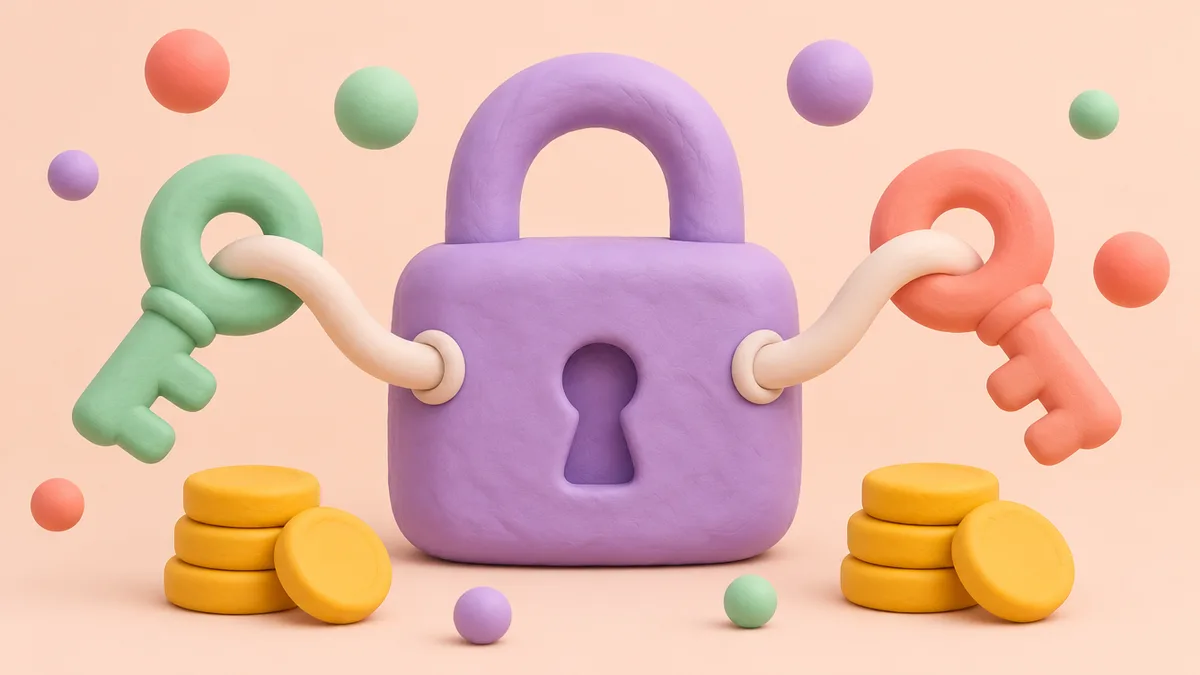
Think of a public key like a letterbox slot and the private key like the only key that opens the box. Anyone can see the slot and post something in; only the key-holder can open it. For blockchains, the more accurate picture is a signature:
- Who can see it — public key: anyone you share it with. Private key: only you (or your custodian).
- Main job in crypto — public key: verify signatures and create addresses. Private key: sign transactions that spend coins.
- Safe to share? — public key: generally yes, with privacy trade-offs. Private key: never.
- If someone gets it — public key: they can watch related activity. Private key: they can move your coins.
The key point: the network never needs your private key. When you send bitcoin, your wallet signs the transaction with the private key and broadcasts the signature plus the public key. Every node can then check the signature against the public key and confirm the spend is genuine — without learning the private key.
Your seed phrase is a human-readable backup that can regenerate your private keys (and from them, your public keys and addresses). That is why a seed phrase must be guarded even more closely than any single key.
How a public key is derived (high level)
Bitcoin and Ethereum both use elliptic-curve cryptography on a curve called secp256k1. At a high level:
- Your wallet picks a huge random number. That number is the private key.
- The wallet multiplies a fixed starting point on the curve by that number. The result is another point on the curve — the public key.
- Going forward is quick. Going backwards — finding the private key from the public key — is believed to be practically impossible with today's computers. This is what cryptographers call a one-way function.
The Bitcoin Wiki's secp256k1 page lists the curve parameters if you want the technical detail. You don't need to understand the maths to use a wallet safely; you just need to know that the public key is calculated from the private key, never the other way round.
Some wallets show a public key as a long hex string — a compressed Bitcoin public key, for example, is 66 characters starting with 02 or 03.
Public key vs wallet address
These two get mixed up all the time. A wallet address is usually a shorter, encoded version of the public key (or of a script that involves it), with a checksum added to catch typos:
- Bitcoin (older formats) — the public key is hashed, then encoded into an address starting with 1 or bc1q.
- Ethereum — the address is the last 20 bytes of a Keccak-256 hash of the public key, shown as 0x plus 40 hex characters. Ethereum.org's accounts documentation explains this.
- Bitcoin Taproot (bc1p) — the address encodes a (tweaked) public key more directly.
In day-to-day use, you share an address, not a raw public key. Our what is a wallet address guide covers address formats, network matching and checking an address before you send.
Where you'll see a public key
Most beginners only meet a public key in a few places:
- Hardware and software wallets — advanced settings may show a public key or an extended public key (xpub, ypub or zpub).
- Watch-only wallets and tax tools — some ask for an xpub so they can track balances without being able to spend.
- Blockchain explorers — on a blockchain explorer, a spent transaction's input data can reveal the public key used to sign it.
- Multisig setups — each co-signer shares a public key so the wallet can require, for example, 2 of 3 signatures.
- Outside crypto — SSH logins, email encryption (PGP) and HTTPS certificates all use public keys.
How do I find my public key? In most wallets, look for "account details", "export public key" or "xpub" in settings. If a screen asks for your seed phrase or private key to "show" your public key, stop — no legitimate wallet needs that.
Safety, privacy and scams
A public key cannot be used to spend your coins, but that doesn't mean you should post it everywhere.
- xpub privacy — an extended public key lets anyone derive every receive address in that account and see your full history and balance. The Bitcoin Wiki's deterministic wallet page explains how this works. Only give an xpub to tools you trust.
- "Verify your wallet" scams — fake support agents and phishing sites ask for your seed phrase or private key while claiming they need your "key" to fix a problem. Your public key or address is all anyone legitimately needs to send you funds.
- Reused addresses — reusing one address links all its activity together; most modern wallets give a fresh address each time.
Moneysmart (ASIC) warns that crypto is high risk and scams are common. Read its crypto assets page, and report scams through Scamwatch.
A simple Aussie example (hypothetical)
This example is entirely hypothetical. The names, amounts and AUD figures are invented to show how keys fit together. They are not a live quote and not advice to buy or send crypto.
Imagine Mia in Perth sets up a Bitcoin wallet on her phone.
- The wallet generates a 12-word seed phrase. Mia writes it on paper and stores it safely offline.
- From the seed, the wallet derives a private key and, from that, a public key.
- The wallet turns the public key into a bc1q... address. Mia sends that address to her brother, who owes her $50 AUD worth of bitcoin.
- Later, Mia spends some of it. Her wallet signs the transaction with her private key. Nodes check the signature using her public key and accept it.
- Mia's accountant asks for read-only access for her records. Mia shares a watch-only xpub with a tax tool she trusts — never her seed phrase — and keeps her own AUD notes of what each transaction was worth at the time.
Australia notes
A few general education points for Australians — not legal or tax advice:
- No one official needs your private key. Banks, the ATO, exchanges and support teams will not ask for your seed phrase or private key. A request for it is a red flag.
- Custodial vs self-custody. On a centralised exchange, the platform usually holds the private keys and you log in with a password. With a self-custody wallet, you control the keys — and the responsibility.
- Keep AUD records. If you dispose of crypto, the ATO generally expects Australian-dollar records. Sharing a watch-only public key with a trusted tool can help track transactions, but it doesn't replace proper records or tax advice.
- Privacy is pseudonymous. Public keys and addresses don't carry your name, but they can be linked to you through exchange records or things you post publicly.
Frequently Asked Questions
What is a public key in simple terms?
A public key is the shareable half of a key pair. Others use it to check your digital signatures or to send you encrypted data; the matching private key stays secret.
Is a public key the same as a wallet address?
Not quite. A wallet address is usually a shortened, encoded form derived from a public key. You normally share the address, not the raw public key.
Can someone steal my crypto with my public key?
No. Spending requires the private key. However, a public key — especially an extended public key (xpub) — can reveal your balance and transaction history.
Can you work out a private key from a public key?
Not in practice. Public keys are derived from private keys with one-way elliptic-curve maths that is believed to be infeasible to reverse with today's computers.
How do I find my public key?
Look in your wallet's account details or advanced settings for "public key" or "xpub". Never enter your seed phrase or private key into any site to see it.
Can I use a public key with Jittie today?
Jittie is in pre-launch. You can join the waitlist at learn.jittie.com/waitlist for launch access and updates.
Jittie is in pre-launch. We're building a linked debit card designed to give merchant-funded Bitcoin back on everyday Australian spending. It is not live yet. Join the waitlist for launch updates.
Eagle BTM Pty Ltd ACN 659 281 820 publishes this education site. Nothing here recommends any platform, service or asset or is a recommendation to buy, sell or hold anything. General information only — not financial, tax, or legal advice.
Related Guides
Bitcoin Rewards Australia: How Aussies Earn BTC in 2026
How Australians earn BTC through cashback cards, apps, browsers, referrals and exchange programs, plus custody checks, ATO tax basics and Jittie’s learn-and-earn education.

Crypto Staking Australia: 2026 Education Guide
Crypto staking in Australia explained for 2026: how proof-of-stake rewards work, liquid vs locked vs exchange earn products, ATO income vs CGT treatment, and the main risks. Education only.
What Is a Crypto Exchange in Australia? 2026 Guide
What a crypto exchange is in Australia, how AUSTRAC registration works, how AUD on-ramps work, and how a centralised exchange differs from a DEX, a Bitcoin ATM and an ASX bitcoin ETF.
Jittie Editorial Team
Crypto Education Specialists
Our team of crypto experts and financial educators are passionate about making cryptocurrency accessible to all Australians. With backgrounds in blockchain technology, finance, and education, we create clear, accurate guides to help you navigate the crypto world safely.